NetSuite ERP: How to Unify Your Systems on One, Easy Platform

Your business can't get far with a tangled web of disparate systems. ERP software straightens out your data flows and streamlines your processes.


Growing a company takes more than hard work and perseverance—it takes efficiency. A business’s operations must work seamlessly together to create the highest production rate possible with the fewest resources. It must also eliminate data siloes, allowing information to flow freely between departments and empower leadership to make sound decisions.


Enterprise Resource Planning (ERP) platforms consolidate all of a company’s systems—including financial, warehouse, and inventory management—onto one database. This unification establishes a single data source, streamlining the information flow so operations work more efficiently.


SuiteDynamics partners with NetSuite to customize and implement NetSuite ERP systems. This platform is the #1 Cloud ERP system, serving over 38,000 customers worldwide. Our experts can help examine your company’s software needs and devise NetSuite solutions that equip it to exceed its loftiest goals.


Schedule a consultation with our team today to discuss your dream operation. We’ll ensure you have the system you need to make it a reality.

Schedule Your Consultation


Key Takeaways


  1. Unified Business Operations - An ERP (Enterprise Resource Planning) system is a digital engine that runs a company by managing all business operations on a single platform, allowing organizations to track everything from raw materials to finished products to finances within one program.
  2. Modular Functionality - Most ERPs operate through interconnected modules like Financial Management, Warehouse Management, Inventory Management, Customer Relationship Management, and Supply Chain Management, all sharing data through a central database for real-time access across departments.
  3. Broad Business Applications - ERP solutions benefit companies of all sizes across diverse industries by eliminating inefficiencies, facilitating accurate reporting, providing real-time project updates, strengthening financial controls, and increasing customer satisfaction.
  4. Deployment Flexibility - Organizations can choose from several deployment models: cloud-based (98% of professionals see this as the future), on-premises (housed on company servers), hybrid (combining both approaches), or open-source (typically requiring self-configuration).
  5. Implementation Considerations - While ERPs offer substantial benefits when properly implemented (as seen in All-Safe's case with doubled productivity and 25% sales increase), nearly 50% of implementations fail without proper planning or partnership with experienced consultants who can customize the system to specific business needs.
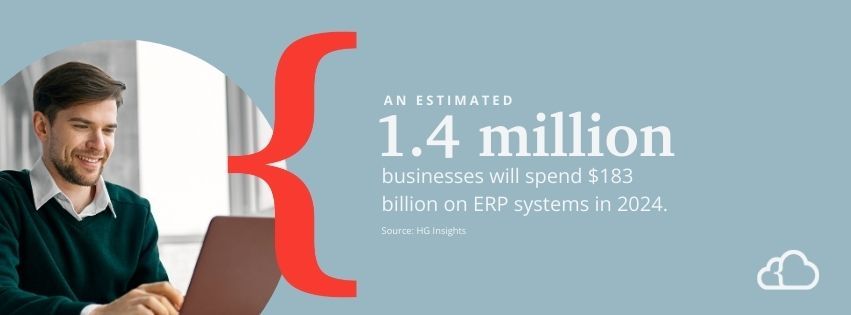

statistic stating 1.4 million businesses will spend $183 billion on ERP systems


What is an ERP?


Think of an ERP as the digital engine that runs a company. In its simplest definition, an ERP is software that manages all business operations on a single platform.


For example, a shoe manufacturer might use a NetSuite ERP to run its accounting, inventory management, and supply chain management systems. Consequently, it would only need one program to track the flow of raw goods to its factory, the items in its warehouse, the packaging and shipping of those items to customers, and the finances associated with the business. 


More and more companies are seeing the value in program unification. In fact, HG Insights estimates that 1.4 million businesses will spend $183 billion on ERP systems in 2024.


“ERP systems have become table stakes for businesses looking to use resources wisely,” NetSuite Senior Associate Content Manager Ian McCue writes. “They can help leaders reallocate human and financial capital or build more efficient core business processes that save money without sacrificing quality or performance.”


Many ERP platforms use a system of modules to handle various operations, connecting them through a central database. Some of the most common modules are:


  1. Financial Management – Found in almost all ERPs. It tracks all transactions, decreases budgeting and forecasting cycle times, accelerates financial close, and ensures compliance.
  2. Warehouse Management – Manages warehouse activities, like packing and shipping. It also increases their efficiency.
  3. E-commerce – This module allows users to manage an online store’s front- and back-end operations. 
  4. Inventory Management – Shows inventory numbers (updated in real-time) and tracks related metrics.
  5. Human Resource Management – Manages employee records and tracks workforce trends. 
  6. Customer Relationship Management – Improves customer service by managing client communications and facilitating leads. 
  7. Order Management – Organizes customer orders and then tracks them to delivery.
  8. Marketing Automation – Helps create a system for building and executing marketing campaigns and measuring their success. 
  9. Supply Chain Management – Tracks and manages goods as they journey from supplier to manufacturing to customers. 


A company can have these modules customized to suit its needs. If an ERP is implemented correctly, various departments can access each system and pull updated data in real-time.


Ultimately, an ERP equips each company division with a wealth of accurate data and analytics, eliminating inefficiencies and data duplications and helping leaders make better decisions.


Schedule a consultation with the SuiteDynamics team to learn more about the NetSuite system and how it can smooth company operations. We’ll ensure the software fits your unique processes, equipping your company to rise in the marketplace.

Schedule Your Consultation
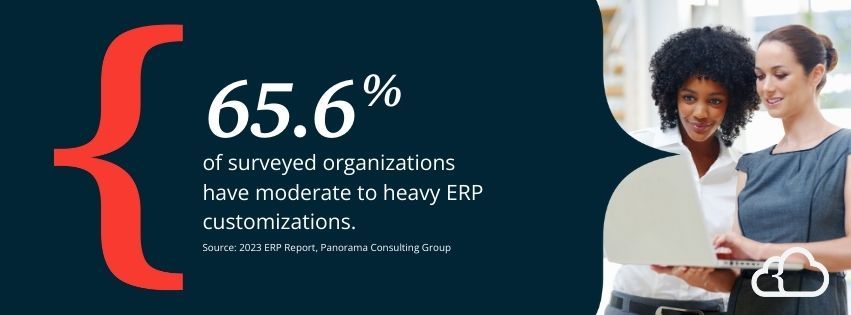
statistic stating 65.6% of surveyed organizations have moderate to heavy erp customizations


Who Uses an ERP?


Various companies—from billion-dollar corporations to mid-size and small businesses—have benefited from ERP investments. The software’s modules give it flexibility and help it scale with the business as it grows. They also allow ERPs to suit nearly any industry, from consulting to hospitality to wholesale distribution


Many businesses deploy ERPs after growing frustrated with single-point solutions, which only address one issue within a company. They don’t coordinate information between departments and are prone to duplications, errors, confusion, and delays.


Instead, companies opt for an ERP that:


  • Cuts costs by eliminating inefficiencies, automating simple tasks, and minimizing errors.
  • Facilitates thorough and accurate key performance indicator reporting and tracks meaningful trends. Consequently, users get overall views of company health as well as detailed business insights.
  • Provides authorized employees fast access to real-time project updates from any area of the company.
  • Tracks each transaction and automates simple financial tasks to produce accurate financial reports that comply with reporting standards and governmental data security regulations.
  • Strengthens financial controls.
  • Allows employees to access information from any device—anywhere in the world.
  • Guards data with the best possible security technology.
  • Allows for minor to significant operational changes as the company grows.
  • Increases customer satisfaction by tracking support tickets, survey responses, etc.


Of course, companies can always adjust the software, adding new capabilities that fit unique needs. Panorama Consulting Group’s 2023 ERP Report says 65.6% of surveyed organizations have moderate to heavy ERP customizations.


“While most companies find that modern ERPs support their businesses ‘out of the box,’ some firms need to add to the extensive built-in functionality,” McCue writes. “If you have a lot of specialized processes, look for an extensible system that allows your integrator or IT staff to write code that adds needed features or that can integrate with homegrown or legacy solutions.”


SuiteDynamics experts specialize in NetSuite customization and can equip your company with bespoke software solutions that enhance your ERP and mold it to your operations. Schedule a consultation to learn more about the system that can streamline your unique processes and boost productivity.



Schedule Your Consultation
statistic 98% of surveyed ERP data professionals believe the platform's future lies in the cloud


Types of ERP Deployment Models


Most ERP systems have three deployment models, which give your company options for housing and interacting with the platform. 


Cloud-Based—This deployment model houses software on third-party servers located off-site. Company employees can then access the platform through a web browser from anywhere in the world. 


Providers often offer cloud-based ERPs through a software-as-a-service (SaaS) delivery model. So, they are responsible for managing, upgrading, and patching the system. 


Many businesses now opt for this type of ERP because it offers greater flexibility than on-premises models and doesn’t require expensive servers and additional IT staff. 


In fact, 98% of surveyed ERP data professionals believe the platform’s future lies with the cloud, according to a study from Frivetran and Dimensional Research.


On-Premises —When they first appeared in the early 1990s, all ERPs were on-premises systems. This means they were housed in servers owned by the businesses that used them and located on company property. 


Although current technology has dented their popularity, on-premises ERP systems still exist. Businesses that use this deployment model are responsible for their ERP’s maintenance, security, upgrades, and patches. The upkeep often requires an entire IT staff.


Hybrid – Some companies, especially those who have used on-premises ERPs for years, opt for a hybrid approach, combining elements of on-premises and cloud-based deployment models. They may use the on-premises platform for their headquarters and switch to a cloud-based ERP for regional offices or use the two systems for different functions. 


Open-Source – Some providers offer inexpensive—or even free—ERP software. Of course, there’s a catch. Users receive little support and typically must configure the platform themselves. 


ERP in Action: The All-Safe Story


More than a decade ago, All-Safe Pool Safety Products  was experiencing problems. 


The business couldn’t manage ballooning data volumes on its QuickBooks software. That accounting system also didn’t integrate with All-Safe’s CRM and inventory systems, so the company couldn’t easily access critical business information. Ultimately, software issues caused delays and hampered growth. 


All-Safe decided to implement a NetSuite ERP system in 2007. This platform tied all the individual systems together, allowing operations to run more efficiently. 


Then, business changed for All-Safe. The company saw steady growth post-ERP implementation. Productivity doubled through on-demand access to financial, inventory and customer information. All-Safe experienced a 25% increase in B2C sales because sales reps and managers gained complete sales force automation and lead-to-order-to-cash management.


Why did a single system make such a difference for this company? The secret lies in the free flow of information between departments and employees.


NetSuite ERP Implementation Made Easy


An Oracle NetSuite ERP may smooth a company’s operations and eliminate inefficiencies, but the platform can get complicated. Many companies that try to implement it themselves often fail, which creates more work and headaches for their staff. Technology Evaluation Centers reports  that nearly 50% of implementations fail the first time without third-party oversight or planning with an ERP partner.


We don’t want your hard work and financial resources to go to waste. SuiteDynamics is a NetSuite Alliance Partner and can help your company implement and customize an Oracle NetSuite ERP to fit your specific needs. Our expertise and ongoing support will protect you from the system’s pitfalls so you only experience its benefits.


Schedule Your Consultation

Shasta Hague is a SuiteDynamics Delivery Manager with over a decade of NetSuite expertise and more than five years in consulting. Her career began in accounting, where she rose from accounting clerk to CFO before transitioning to a Lead Financial Consultant and, ultimately, advancing to her current leadership role. She holds numerous NetSuite certifications—including Suite Foundations, NetSuite Administrator, Financial User, Advanced Revenue Management, and Multi-Book—and an MBA with an emphasis in accounting from Grand Canyon University. Currently, Shasta resides in Tennessee with her husband and two of her four children.


We pull information from NetSuite material, SuiteDynamics experts, and other reliable sources to compose our blog posts and educational pieces. We ensure they are as accurate as possible at the time of writing. However, software evolves quickly, and although we work to maintain these posts, some details may fall out of date. Contact SuiteDynamics experts for the latest information on NetSuite ERP systems.

March 27, 2026
Spreadsheets built modern business. For decades they served as the unofficial operating system of job shops and custom manufacturers everywhere. They are flexible, familiar, and just comfortable enough to feel like a real solution. In the early days of a growing shop, they genuinely work. But as make-to-order complexity increases, as custom BOMs multiply, lead times tighten, and engineering revisions pile up, spreadsheets strain under the pressure. Every job is different, but spreadsheets want everything to be the same. In make-to-order environments, no two jobs are identical. Unique BOMs, custom routings, variable material costs, different setup requirements, customer-specific specs. Spreadsheets, though, thrive on repetition and standardized rows. So the more variation you introduce, the more tabs you create. The more exceptions you add, the more manual overrides appear. The more formulas you patch together, the more fragile the whole thing becomes. Eventually, the file turns into something only one person truly understands. That’s a liability, not a system. Capacity becomes a guessing game. In make-to-order shops, capacity isn’t theoretical. It’s constrained by reality. Machines go down. Operators vary in skill. Setup time fluctuates from job to job. Rush orders blow up carefully planned weeks. Spreadsheets struggle here because they’re built on static inputs. You can build a beautiful planning sheet with machine-hour allocations, but unless it dynamically adjusts for real-time job status, operator availability, overlapping resource conflicts, and maintenance downtime, you’re not really planning. You’re forecasting best-case scenarios. And that’s exactly how shops overpromise delivery dates and end up paying for it later in overtime and expediting costs. Engineering changes don’t cascade cleanly. Change is a constant in make-to-order manufacturing. A customer tweaks a dimension, a material substitution becomes necessary, or a tolerance tightens halfway through production. In an integrated system, that change automatically updates BOMs, routings, cost projections, and scheduling impact all at once. In a spreadsheet environment, it depends entirely on who remembers to update which tab. A routing might change without adjusting the labor estimate. A material substitution might never feed into the margin calculation. A lead-time adjustment might not reach the production schedule until it’s too late. These small disconnects multiply quickly, and because spreadsheets have no enforced relationships between data sets, the errors don’t announce themselves. Institutional knowledge becomes a single point of failure. Ask most growing job shops who owns the master spreadsheet and you’ll get a name. One estimator, planner, or operations manager who has become the living interpreter of years’ worth of embedded formulas, assumptions, and logic that nobody else fully understands. This works fine until it doesn’t. When that person goes on vacation, gets sick, or leaves, the shop loses operational clarity. In an environment already defined by complexity, having critical knowledge live inside one person’s mental model of a file is an inefficient bottleneck. Visibility stops at the file boundary. Spreadsheets are static snapshots. Make-to-order manufacturing is anything but. Without real-time feedback loops, shops find themselves unable to answer questions that should be simple: Are we actually on track this week? Which jobs are consuming more labor than quoted? Where is the bottleneck right now? Which customers consistently drive margin compression? When performance data doesn’t flow automatically from the floor back into quoting and planning, improvement stalls. You can’t refine what you can’t see. Here’s the thing about spreadsheet failure in manufacturing… it’s not dramatic. It’s gradual. First the files get slow, then fragile, then opaque. By the time leadership feels the real pain through late shipments, squeezed margins, and rising overtime, the architectural issues are widespread. Make-to-order manufacturing demands systems that understand relationships: how a routing affects capacity, how a BOM revision affects cost, how a delayed job cascades through the rest of the schedule. The question most shops ask is whether they can make the spreadsheets work. The better question is what it’s actually costing to keep them. The most resilient make-to-order manufacturers are building systems that preserve flexibility without sacrificing the visibility needed to actually run the business. Adaptability is the advantage. 
March 23, 2026
In custom manufacturing , when systems break down, profit rarely disappears all at once. It leaks. Quietly, repeatedly, and often in ways that never show up clearly on any report. Walk into almost any fabrication shop and you’ll hear some version of the same story: the backlog is strong, revenue looks good, we’re staying busy. And yet the margin feels thinner than it should. For job shops running custom work, profitability doesn’t usually collapse because of one bad decision. It erodes through small, daily inefficiencies buried inside quoting, scheduling, engineering changes, and the gap between what was planned and what actually happened on the floor. Here’s where shops most commonly lose efficiency, and how to get it back. The quote that was almost right. For custom orders, every quote is a prediction, and predictions are dangerous when they’re disconnected from real shop-floor data. Outdated labor standards, underestimated setup time, material prices that changed since the template was built, and capacity assumptions based on average weeks instead of current reality. These errors are each small on their own, but a 4% underestimate on labor here, a missed secondary operation there, add up across hundreds of jobs. Small errors compound into real margin loss. The best-performing shops treat quoting as a living system fed by actual job performance data, not static spreadsheets that nobody updates. Capacity that looks available but isn’t. On paper, there’s open space on the schedule. In practice, that open week includes a machine down for maintenance, a senior operator on vacation, two complex jobs already competing for the same bottleneck, and a rush order someone verbally committed to last Thursday. Without finite capacity planning, shops routinely overcommit based on theoretical machine hours rather than real-world constraints. The fallout is predictable: overtime spikes, expedited shipping costs, re-sequencing chaos, and exhausted operators. Margin shrinks not because the shop is incapable, but because it’s planning in averages. Engineering changes that never get repriced. Designs evolve. A hole moves, a weld spec changes, or a tolerance tightens. Each adjustment has a cost. But many shops hesitate to reprice midstream, worried about damaging the customer relationship, and end up absorbing the extra labor and rework time instead. Do this enough times and it becomes a cultural norm: “we’ll just take care of it.” That’s margin erosion disguised as good service. High-performing job shops track engineering change impact in real time and make repricing decisions based on data rather than discomfort. Setup time hiding in plain sight. In low-volume, high-mix environments, setup time is often the silent killer. When shops don’t track setup separately from run time, assume it’ll all come out in the wash, and never refine their routings based on what actually happened, they end up underpricing complexity. In job shops producing one to fifty unit runs, setup can represent a disproportionate share of total labor. If it isn’t measured accurately, it can’t be priced accurately. The spreadsheet layer nobody talks about. Most shops run a hybrid environment where the ERP handles transactions and spreadsheets handle reality. Capacity lives in one file, quoting assumptions in another, and actual job performance in someone’s head. This creates invisible disconnects. Quotes not aligned with current routing, schedules that don’t reflect real constraints, and historical performance that never feeds forward into better decisions. Each disconnect feels manageable in isolation. Collectively, they create margin leakage that leadership can feel but can’t quite locate. What makes all of this so frustrating isn’t that shop owners don’t care. It’s that they can’t see clearly enough to act decisively. Without integrated visibility across quoting, routing, capacity, and quality, operators run on instinct. And instinct works remarkably well until scale and complexity outpace it. The shops that consistently outperform aren’t necessarily the biggest or the busiest. They operate with clarity and consistency. Fewer assumptions and more decisions based on reality. In a manufacturing landscape where lead times keep shrinking and customers expect speed and precision at the same time, margin won’t be protected by effort alone.
January 5, 2026
Every manufacturing leader has lived this moment: The schedule looks perfect. Orders are slotted. Commitments are made. And then reality shows up. A machine goes down. A key operator calls out. Setup times balloon. One late job cascades into five. Suddenly the plan (built meticulously inside your ERP) falls apart. Not because your team failed, but because the plan was never grounded in reality to begin with.  The Hidden Lie Inside Most ERP Schedules
August 27, 2025
NetSuite’s Model Context Protocol (MCP) , built in partnership with Anthropic, helps users leverage AI to ask simple, natural-language questions and get back complex, structured analysis, all powered by live NetSuite data. This practical use of AI can be used to generate reports, create or update records, perform queries, analyze reports, automate workflows, or make predictions based on real-time data. Here's how you can get started and connect AI to NetSuite using MCP: 1. Login to NetSuite and navigate to Customization → SuiteCloud Development → SuiteApp Marketplace. 2. Search “MCP Tools” > Click on the icon and install the MCP Tools SuiteApp
job shop manufacturing
June 20, 2025
Job shop manufacturing is a production method where small batches of 1-100 units of customized or unique products are made to meet specific customer requirements. Unlike mass production, each order typically requires unique setups, specialized processes, and custom routing through the facility. In this comprehensive guide, you'll learn: The complete definition of job shop manufacturing How job shops differ from other manufacturing types Industries that rely on job shop methods Technology solutions that optimize job shop operations When to consider implementing specialized ERP systems What is Job Shop Manufacturing? (Definition) Job shop manufacturing is a production strategy focused on customization over volume . Instead of producing thousands of identical items, job shops create small quantities of unique products tailored to specific customer specifications. Key defining characteristics: Small batch sizes - Typically 1-100 units per order High product variety - Hundreds or thousands of different products Custom specifications - Each order has unique requirements Project-based workflow - Work orders last days to weeks Skilled labor - Requires specialized expertise and flexibility Job Shop is a powerful, fully integrated solution built for custom manufacturers, combining quoting, configuration, production, and fabrication workflows inside NetSuite. Learn more about SuiteDynamics' NetSuite Job Shop for Manufacturing.
A man is holding a box and a woman is looking at a tablet in a warehouse.
By Grace Martin May 27, 2025
Uncover the challenges of data quality affecting DIO accuracy, from ghost inventory to inconsistent formats. Find out how to tackle these issues effectively with a NetSuite ERP.
May 8, 2025
In the world of private equity, creating operational value has become increasingly critical as the market evolves. With exit timelines extending and competition for deals intensifying, PE firms are looking beyond financial engineering to drive returns. One emerging strategy that's gaining traction is the consolidation of NetSuite instances across portfolio companies. The Hidden Challenge of System Fragmentation As PE portfolios grow through acquisition, a common pattern emerges: multiple portfolio companies operating on separate NetSuite instances. While each system may work effectively in isolation, the fragmentation creates significant operational inefficiencies at the portfolio level: Redundant Licensing Costs: Each separate instance requires its own licensing structure , creating unnecessary expenses that directly impact EBITDA. Manual Consolidation Effort: Finance teams spend countless hours extracting, transforming, and manually consolidating data from disparate systems. Inconsistent Processes: Basic business functions are handled differently across portfolio companies, limiting standardization efforts. Limited Portfolio-Wide Visibility: Gaining insight across the entire portfolio requires extensive manual effort, delaying strategic decision-making. Integration Challenges: Onboarding new acquisitions becomes increasingly complex when each company maintains its own environment.
Esusu logo
April 30, 2025
Explore Esusu's partnership with SuiteDynamics to enhance financial processes. Schedule a consultation to see how your business can thrive with NetSuite solutions.
Image of an office worker and a laptop, illustrating the concept of case management setup.
By Brittany Klecker April 30, 2025
Discover how to effectively set up and configure case statuses, rules, types, priorities, and more in NetSuite's case management system. Streamline your workflow and improve customer support with this comprehensive guide.
A man is holding a stack of cardboard boxes in a warehouse.
By Grace Martin April 26, 2025
Backorders disrupt revenue and frustrate customers. Learn what "backordered" means, how backorders happen, their impact on businesses, and how NetSuite ERP can minimize the issues.
More Posts